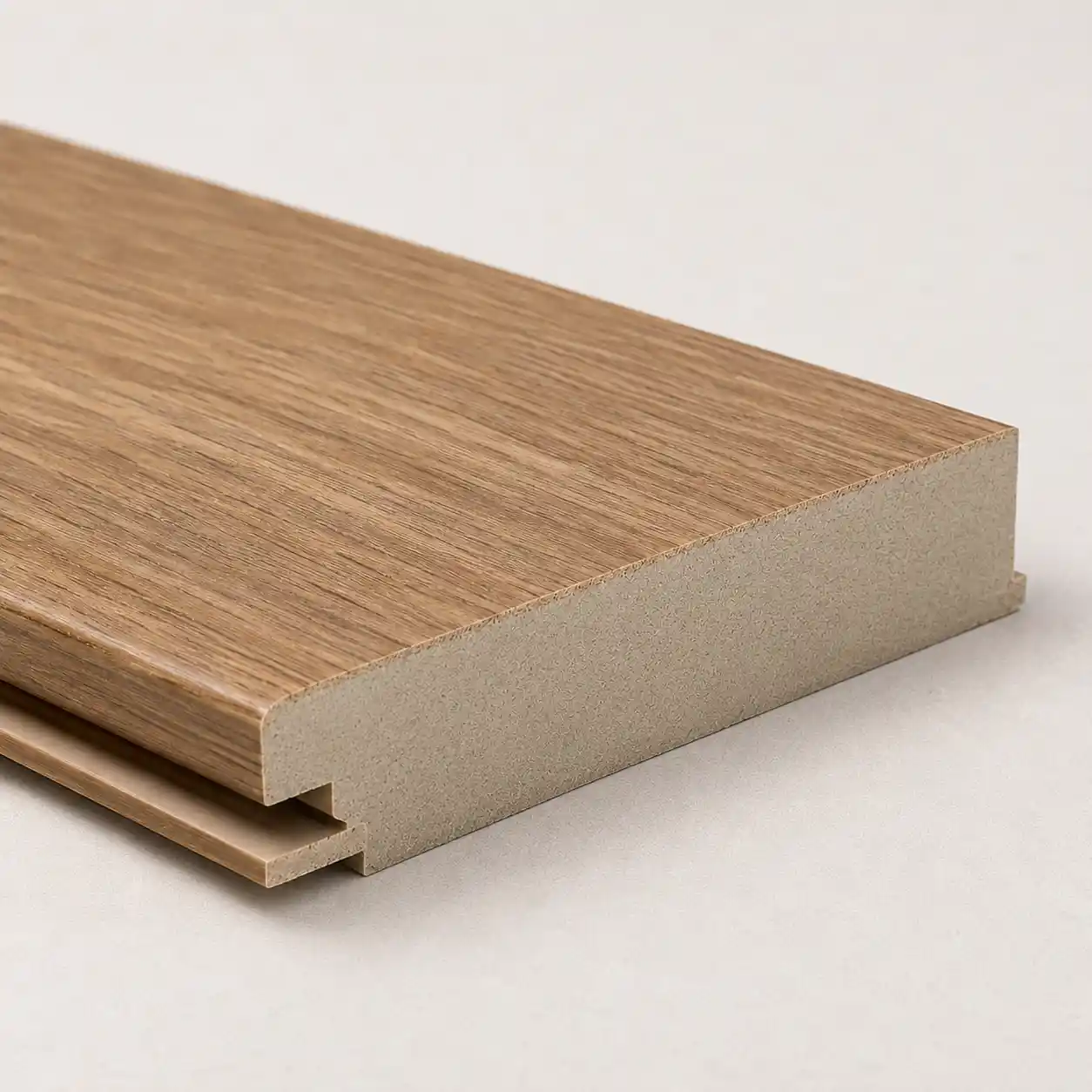
Краткий ответ: A WPC panel cross section usually tells you four practical things: how the surface is finished, how the composite core is built, whether the profile is hollow or solid, and how the edge will connect with trims. Those details affect appearance, cutting, installation, wall stability and the finished look in villa, hotel and commercial interiors.
Do not judge a WPC wall panel by the front color alone. If you are planning a villa TV wall, hotel room, office feature wall or restaurant interior, compare the cross section with the actual wall height, groove profile, lighting and trim plan before asking for samples. For project selection, start with our WPC wall panel options, compare WPC fluted wall panels, and check отделочные элементы и аксессуары для стеновых панелей before final quotation.

What Is a WPC Panel Cross Section?
A WPC panel cross section is the cut face of a wood plastic composite wall panel. It shows the internal profile, not just the decorative front surface. For buyers, designers and renovation teams, this view is useful because it reveals the panel thickness, internal cavity, surface layer, back structure and edge detail.
That small cut face often answers questions a product photo cannot. Will the panel feel light or rigid? Is the groove deep or shallow? Can the edge be finished neatly? Is the profile easy to cut around sockets? Will the trim cover the joint cleanly? These are the details that decide whether the wall looks professional after installation.
For villa, hotel and commercial interiors, the cross section should be read together with the room plan. A slim profile may look calm in a bedroom. A deeper fluted profile may suit a TV background wall or hotel lobby. A lighter hollow structure may be enough for many decorative interior walls, while some projects may prefer a more solid-feeling profile in areas where rigidity matters.
The 5 Parts You Should Check in a WPC Wall Panel Cross Section
When comparing WPC panels, do not stop at color. A good sample check should include the visible surface, the core, the inner profile, the edge and the way accessories fit. The table below gives a practical way to read the cross section before you move into samples or quotation.
| Cross Section Part | What It Shows | Why It Matters for Projects |
|---|
| Decorative surface layer | Color, film, texture, gloss level and wood-grain direction. | Controls the final visual effect, especially under villa, hotel or showroom lighting. |
| Composite core | The body of the WPC panel behind the surface finish. | Affects cutting feel, rigidity, weight and how stable the panel feels on the wall. |
| Hollow or solid profile | The internal structure, including cavities or a denser body. | Influences weight, handling, perceived strength and where the profile is best used. |
| Groove or fluted shape | The depth, width and rhythm of the visible profile. | Creates shadow lines for TV walls, hotel rooms, corridors and commercial feature walls. |
| Edge and back detail | How the side, back and trim connection are formed. | Determines how corners, endings, joints and transitions look after installation. |
A small but useful habit: ask for a cross section photo together with the front surface photo. The front view tells you the style. The cross section tells you whether that style can be installed cleanly in your project.
Hollow vs Solid WPC Panels: Which Cross Section Is Better?
There is no honest one-word answer. Hollow and solid WPC profiles solve different problems. A hollow WPC panel is not automatically low quality, and a solid profile is not automatically the best choice for every wall. What matters is whether the profile matches the room, the wall height, the installation method and the visual result you want.
When a hollow WPC profile can make sense
Hollow or semi-hollow profiles are common in decorative interior wall panels because they reduce weight and can be easier to handle during installation. For many living rooms, bedrooms, corridors, offices and hotel guest rooms, the panel is used as a decorative wall finish rather than a structural material. In that case, the hollow design can be perfectly reasonable if the profile, thickness and edge detail are suitable.
When a more solid-feeling profile may be preferred
Some projects prefer a heavier or more rigid-feeling panel, especially where the wall is tall, the profile is deeper, the edges are exposed, or the client wants a premium hand feel. In these cases, the cross section matters because it helps you compare the inner support, surface thickness and trim compatibility before selecting the final sample.
If you are choosing for a villa TV wall, hotel room, office reception area or restaurant feature wall, do not ask only, “Is it hollow or solid?” A better question is: “Which profile suits my wall size, lighting, trim plan and installation method?”
How Cross Section Affects Installation, Cutting and Trims
Many wall panel problems appear at the edges, not in the middle of the wall. The cross section helps you plan those edges before the installer is already on site.
For example, a deep fluted WPC panel may look excellent on a feature wall, but socket cuts and outside corners need more care. A very slim profile may create a cleaner modern look, but the installer still needs to know how the edge will be finished. If the panel ends at a doorway, a cabinet, a ceiling line or another material, trim selection becomes part of the design, not an afterthought.
Before confirming an order, check these installation details:
- How the panel will be cut around sockets, switches and wall lights.
- Which inside corner, outside corner and end trims match the profile.
- Whether the back structure suits adhesive fixing, mechanical fixing or the planned substrate.
- How joint lines will align across a long wall or repeated hotel room layout.
- Whether the groove direction works with the wall height and lighting direction.
If you are still planning accessories, review our отделочные элементы и аксессуары для стеновых панелей. Good trim planning is one of the simplest ways to make WPC panels look more finished and less like a rushed renovation.
Which WPC Panel Structure Works for Villas, Hotels and Commercial Interiors?
The right WPC cross section depends on the space. A private villa, a hotel guest room and a restaurant wall do not ask the same thing from the panel.
| Project Type | Useful WPC Profile Direction | What to Check Before Samples |
|---|
| Villa TV wall or living room | Wood-look WPC or fluted WPC with a clean groove rhythm. | Color warmth, wall height, lighting, furniture tone and edge trims. |
| Bedroom, study or corridor | Slimmer profiles or calmer wood-grain finishes. | Surface gloss, cleaning needs, acoustic comfort and joint direction. |
| Hotel guest room | Repeatable WPC profile with stable finish codes and clear trim details. | Batch consistency, maintenance, headboard wall details and installation speed. |
| Restaurant, retail or office feature wall | Deeper fluted profiles or stronger decorative rhythm. | Lighting angle, corner protection, cleaning frequency and socket cuts. |
For broader style comparison, visit our Стеновые панели из композитного материала (WPC) page. If your project needs a stronger grooved design, compare fluted wall panels and WPC fluted wall panels.
Common Mistakes When Judging WPC Panel Quality from Cross Section Photos
Cross section photos are useful, but only if you read them in context. These are the mistakes we see project buyers make most often:
- Only checking the surface color. A beautiful front surface still needs the right edge, thickness and trim plan.
- Assuming all hollow profiles are weak. Hollow profiles can work well for many decorative interior walls when the structure suits the application.
- Choosing deep grooves without thinking about cleaning. Deep shadow lines look strong, but the room type and cleaning frequency matter.
- Ignoring corner trims. Corners, endings and transitions decide whether the wall looks custom or unfinished.
- Comparing thickness alone. Thickness matters, but profile design, core structure and surface finish also affect the finished result.
- Approving samples under the wrong lighting. Wood-grain color can look different under warm indoor lighting, daylight and showroom lighting.
The best sample decision is usually made with a front photo, a cross section photo, a trim plan and a short description of where the panel will be installed.
What to Ask Before Ordering WPC Wall Panel Samples
If you are comparing WPC wall panels for a villa, hotel or commercial interior, ask practical questions before discussing final price. A supplier who can answer these clearly is easier to work with during the real project.
- Can you provide a clear WPC panel cross section photo?
- What is the panel thickness and profile type?
- Is this profile hollow, semi-hollow or solid?
- Which trims match this exact profile?
- Can I see the same color under natural light and warm indoor light?
- Is this profile suitable for a villa TV wall, hotel room or commercial feature wall?
- How should sockets, corners and exposed edges be handled?
For a more accurate recommendation, send your wall size, room type, preferred finish and one or two reference images. Yifang can help match WPC panel profiles, trims and sample options before quotation, instead of asking you to choose from a catalog without context.
Recommended Yifang Pages for WPC Panel Selection
If you are using this guide to prepare a real project, these pages will help you move from structure knowledge to product selection:
FAQ About WPC Panel Cross Section
What does a WPC panel cross section show?
It shows the decorative surface layer, composite core, hollow or solid profile, back structure and edge detail. These points help buyers judge installation, cutting, trim matching and project suitability.
Is a hollow WPC wall panel bad quality?
No. A hollow WPC panel is not automatically bad quality. Hollow profiles are often used for decorative interior walls because they reduce weight and can be easier to handle. The key is whether the profile suits the wall size, installation method and room use.
What thickness is best for WPC wall panels?
There is no single best thickness for every project. The right choice depends on wall height, profile shape, edge exposure, installation method and the visual result you want. Always compare thickness with the full cross section, not as a single number.
Are WPC panels suitable for villa TV walls?
Yes. WPC panels and WPC fluted panels are commonly used for villa TV walls, living rooms, bedrooms and corridors when the color, groove profile, trims and lighting match the interior design.
What should I check before asking for WPC panel samples?
Prepare wall dimensions, room type, lighting condition, preferred surface finish, trim needs, socket positions and one or two reference images. Then ask for front surface photos, cross section photos and matching trim details.


 English
 العربية
 हिन्दी
 Español
 Français
 Português
 Deutsch
 Русский
 ไทย
ไทย